Medieval
Clothing Care
Traditional Remedies & Recipes for Care &
Management of Clothing
CLEANSING - WATERPROOFING - STAIN REMOVAL - RESTORING
COLOUR - RE-HEMMING TO EXTEND WEAR
- IRONING - CARE OF FURS - STORAGE OF CLOTHING
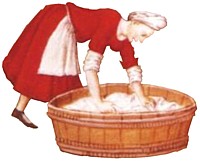 How
did medieval women wash their clothes? Did they wash them? Where?
And with what? It's hard to imagine washing some of those grand
silk velvet court clothing down at the stream. And if one lived
in the city, what then? How
did medieval women wash their clothes? Did they wash them? Where?
And with what? It's hard to imagine washing some of those grand
silk velvet court clothing down at the stream. And if one lived
in the city, what then?
We know that in medieval
London, townswomen washed at a common wash-house. It was a woman's
domain, where news and gossip was exchanged while washing clothing.
In medieval Spain, any bridge leaving town was required to be
wide enough for two women and their water jugs. Since men were
not expected to be at places where woman washed, only other women
were permitted to act at witnesses in disputes if they happened
at the river or stream.
Fortunately, there is some
information of clothing care which has been preserved for posterity.
The best known examples of domestic instruction come from a treatise
known as the Goodman of Paris which was written in 1393
by an elderly Parisian for his 15 year old bride. It is primarily
concerned with good behaviour and on the running of a household.
Here and there, in other manuscripts, a snippet of information
also appears.
Cleansing
of clothes
It is generally accepted that outer clothes were not washed after
every wear, in the same manner that you would not wash an overcoat
or wool jacket after every wear. Heavy outer clothing was shaken
after wear to remove dust, sometimes with a light beating with
a brush or whisk of dry twigs.
General clothing at home could be rinsed carefully by hand in
a tub of heated water. Underclothes were rinsed more frequently
and hung to dry over a pole. Woolen clothes with a long nap could
be reshorn when they were very dirty or worn to expose a fresh
new surface. 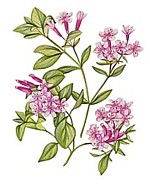 The
cost of shearing was averaging 1s a cloth at the time of Bogo
de Clare. It was a skilled procedure which was deemed to be fairly
expensive. The
cost of shearing was averaging 1s a cloth at the time of Bogo
de Clare. It was a skilled procedure which was deemed to be fairly
expensive.
Soapwort, Saponaria officinalis
(at right), was a herb used for cleaning cloth and clothing. Also
known as bruisewort, dog cloves, fuller's herb and latherwort,
soapwort grew originally in northern Europe until its introduction
to England by Franciscan and Dominican monks. When the leaves
are crushed, they make a fine lather like a liquid soap which
works well and is extremely gentle on delicate fabrics.
By the end of the 16th century the use of soapwort had become
widespread in England for laundering, fulling and washing dishes.
Many museums still use soapwort to this day for its ability to
gently cleanse delicate fabrics.
The use of the herb marjoram, Origanum vulgare (also known
as organum or oregany), lent its scent in washing waters.
According to a British historian,
washing at the wash-house was rinsed, twisted and beaten where
the tongues are quite as active as washerwoman's beetles.
Waterproofing
We know from English warderobe records of the 14th century, that
wax was bought specifically for the purpose of waxing garments
for weatherproofing.
Exactly which garments were treated this way is not mentioned
but it can be assumed that they were outer garments for winter
or wet weather, most likely cloaks. This was not an option for
peasants who would have used the wax for more important things,
and would have relied on felted wool for protection from the elements.
Happily, felted wool is remarkably weatherproof.
Stain
removal
There are many interesting medieval recipes for the use of stain
removal on clothing. Fuller's Earth was recommended if soaked
in lye for other kinds of stain removal. It must be applied to
the stain, allowed to let dry and then rubbed. 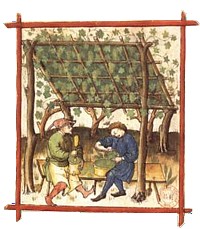
Ashes soaked in lye and put onto the stain was also believed to
be good.
For dresses of silk, silk damask, satin, camlet 'or other material',
soak and wash the stain in verjuice (from Middle French vertjus
"green juice" - an acidic juice made by pressing unripe
grapes) and it will be cleaned. An image of verjuice being made
from the 14th century French manuscript, Tacuinum Sanitatis,
is shown at right..
Recipes for the removal of
grease and oil were somewhat more complex. One recipe is such:
To remove grease or
oil stains, take urine and heat until warm. Soak the stain
for two days. Without twisting the fabric, squeeze the afflicted
area, then rinse. As an alternative for stubborn greasy or
oily stains, soak in urine with ox gall beaten into it, for
two days and squeeze without twisting before rinsing.
Chicken feathers were also
recommended as a cleaning aid. Firstly they must be soaked in
very hot water then wet again in cold water. The stain may then
be rubbed with the feathers and it will be clean. Exactly how
successful the feathers method was is unclear.
Restoring
colour to faded garments
Remedies to restore the fading were also available. This advice
is offered:
On a pale blue garment,
a damp sponge dipped in clear, clean lye should be squeezed
out and then wiped over the offending area, or to restore fading
on clothes of other colours, use very clean lye with ashes on
the spot. It must be left to dry, then rubbed. The colours shall
then be restored.
If a dress is of silk, silk
damask, satin, camlet 'or other material' soak and wash the stain
in verjuice which has been stored without salt and its colour
will be restored.
Re-hemming
to extend wear
 We
know that the parts of a women's gown which wear most are the
cuffs and the hem. Our medieval woman counterparts faced the same
issues as us today, and it comes as no real surprise to see that
their solutions were the same. We
know that the parts of a women's gown which wear most are the
cuffs and the hem. Our medieval woman counterparts faced the same
issues as us today, and it comes as no real surprise to see that
their solutions were the same.
It was not unknown for a woman to cut the very hem of her gown
off when it was too ragged and re-sew it a little shorter or to
replace it with a strip of new fabric.
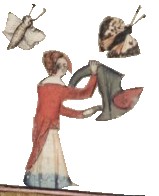
Shown at right is a picture from the Romance of Alexander showing
a woman catching butterflies who appears to have rehemmed her
dress.
At first I thought that this may be purely decorative, but in
Toni Mount's book, Everyday Life in Medieval London, we
read that in 1320, the household wardrobe accounts of Edward II's
wife Queen Isabella herself had garments re-hemmed to prolong
the wear of them and save the cost of new gowns. This could hardly
have been an unusual thing to do, or it would have been much made
of.
Ironing
Many people consider the iron to be a modern invention but versions
of tools used to flatten and de-crumple clothes have been around
for centuries. Vikings from Scandinavia had early irons made of
glass and roughly mushroom-shaped by about the tenth century.
These were also called linen smoothers. The smoother was warmed
in steam before it was rubbed across the clothing.
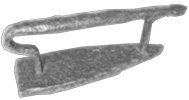 According
to historians of domestic household appliances, it was during
the 1300s that the tool we recognise as an iron first appeared
in Europe. According
to historians of domestic household appliances, it was during
the 1300s that the tool we recognise as an iron first appeared
in Europe.
It was comprised of a flat piece of iron with a metal handle attached.
The flatiron was held over or in a fire until it was heated, when
it was picked up by the handle with a padded holder. A thin cloth
was placed between the iron and the garment in order not to dirty
the clothing whilst the ironing process took place.
The iron above is described as having a salamander-shaped handle
and dates to the 15th century.
Care
of furs
Fur was extensively used throughout the medieval period both as
trimming for clothing and as linings. Cleaning furs without damaging
them, especially the hems which came in contact with floors and
mud, was necessary.
A remedy to revive furs or fur skins which have become hard through
wetness was given as: the fur must be removed from the garment
and sprinkled with wine. It should then be
'sprayed by mouth as
a tailor sprays water on the part of a dress he wishes to hem'.
Flour must be put on the
wetted parts. It must then dry for a day or so, before rubbing
well and it will return to its original state.
 Storage
of clothing Storage
of clothing
Wardrobes as we know them today do not seem to be depicted with
great regularity in medieval art and it is thought that general
storage of linen and clothes was in large wooden chests.
Pictured right is a detail from the 1470 painting, The Birth
Of Mary showing a large, wooden chest for the storage of linen.
 A
15th century German manuscript, at left, shows a garment hanging
on an early version of a coathanger, but this was for the sewing
of the garment, and not for storage. A
15th century German manuscript, at left, shows a garment hanging
on an early version of a coathanger, but this was for the sewing
of the garment, and not for storage.
My own thoughts are that many of the garments were heavy wools,
often lined with furs, and storage on a coathanger may have produced
extra strain of the shoulder seams. Chests of drawers do not seems
to have been used. Chests themselves, though, are shown in many
artworks.
Airing of dresses was encouraged
to avoid moths and their larvae. This was a practice which must
be done on a sunny day in the summer and dry months for if the
dresses are put away in a chest after airing on a cloudy day,
the cold air will be folded into the dress and encourage vermin.
Roses of Provins were also
considered the best for putting in dresses. The Goodman of
Paris says that these must be dried in mid-August and sifted
in a seive so that all the worms fall out and then the petals
may be scattered on the dresses.
 Pest-repellants Pest-repellants
Many household washing and storing of cloth and clothing involved
the use of herbs either to make the linen sweet-smelling or to
discourage harmful insects.
In the late 15th century, a mixture of powdered anise and orris
iris florentina was used to perfume household linen in
storage. Medieval linens were also scented with lavender, Lavendula
vera, by being stored with it or rinsed in lavender water.
Rue, Ruta graveolens,
also known as the Herb o' grace o' Sundays was used in linens
to keep away bugs and noxious odors. The image at right from the
Tacuinum Sanitatis shows two men collecting rue.
Wormwood, Artemesia absynthum,
was the most common element cited in recipes to protect medieval
clothing from damage whilst in storage. It was often placed among
woolen cloths to prevent and destroy moths.
A mixture of wormwood, southernwood, the leaves of a cedar tree
and valerian mixed together and put wherever clothes were stored
was thought to help repel moths and other vermin.
Copyright
© Rosalie Gilbert
All text & photographs within this site are the property of
Rosalie Gilbert unless stated.
Art & artifact images remain the property of the owner.
Images and text may not be copied and used without permission.
|