Medieval
Women's Hoods
THE SHAPE OF HOODS - HOOD CLOSURES - FABRICS
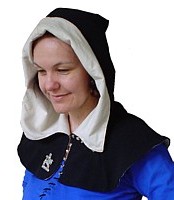 Medieval
hoods were an item of clothing worn by both women and men in the
working class, the upper and the lower classes. Medieval
hoods were an item of clothing worn by both women and men in the
working class, the upper and the lower classes.
Primarily used for warmth out of doors, both women's and men's
hoods were essentially the same style and pattern, changing only
a little over the course of the middle ages.
The
shape of the hood
Early in the medieval period, hoods were purely functional with
little or no ornamentation. This changed towards the fourteenth
century when hoods became more of a fashion item.
The basic shape of the medieval
hood was little more than a square for the head attached to a
semicircle for the shoulder cowl. Variations on this basic shape
gave the hood its definition over the next few centuries. The
square shape of the head covering part of the hood became elongated
at the front and a small gore was cut into the lower portion which
was used for adding in as a gore over the shoulder to provide
a rounded fit.
 Many
hoods were extremely practical and featured a cowl which came
down to the elbows and pulled on over the head to maximise warmth. Many
hoods were extremely practical and featured a cowl which came
down to the elbows and pulled on over the head to maximise warmth.
The hood became yet another way for the wealthy to further display
their status by adding unnecessary streamers called tippets
or liripipes from the back of the hood.
These ranged from the very modest for the poorer person who could
not afford to spend money on unnecessary expensive fabric, to
the very long, showy extensions of the wealthy. In the earlier
centuries, hoods were looser and larger, but into the 14th and
15th centuries, women's hoods became smaller, had shorter cowls
and were tighter fitting around the face.
Hood
Closures
Women's hoods previous to the 14th century were usually stitched
together at the front, often with a long cowl like the traditional
shape of a monk's hood. It provided much-needed warmth from winter
chills, especially when traveling since most cloaks did not appear
to have a hood attached at that time.
With the rising merchant middle classes having more disposable
wealth available to them into the 14th and 15th centuries, women's
hoods were often buttoned with either handmade buttons of cloth
made to match the hood itself or round metal buttons spaced closely
together. 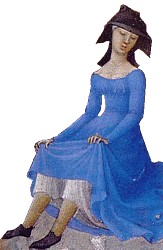
A hood recovered from a deposit in London, England, show a the
button-holes closely spaced at the front and set right at the
very edge of the fabric.
Often hoods are depicted in manuscripts without buttons altogether
and worn draped about the head. Hoods were generally constructed
so that they might be folded back at the face showing off the
contrasting lining or pulled over the face for traveling in bed
weather.
In fine weather, they would be worn by women with the opening
folded back as seen in the detail from the 1412-1416 illumination
from the Limbourgh Brothers famous Duk du Berry's Livres de
Heures for the month of February, shown right.
Fabrics
Hoods could be made from whatever material was available to the
wearer, although wool was worn by all classes. Its warmth and
resistance to water made it an ideal material for traveling or
in poor weather. As with all other aspects of clothing, the wool
used to make hoods for the lower classes differed in quality from
the fine wools used to made hoods for the upper classes.
Silk and silk velvet were
both fabrics which were unavailable to many and expensive for
all. If one was wealthy but could not afford the enormous cost
of a silk garment, one might be able to afford the much smaller
amount of fabric required for a silk or velvet hood.
Consumers in the upper echelons of society might choose a fine,
bright-coloured silk outer lined with wool for warmth.
As with most other items of medieval clothing, a hood was likely
to be lined for a more wealthy wearer than for a poorer one. If
a hood was lined at all, it was almost always lined in a contrasting
colour but also with fur for cold weather wear.
  Hood
decoration Hood
decoration
A large number of decorated hood in manuscripts are seen on
men. There are a small number in the French manuscript, The
Romance of Alexander.
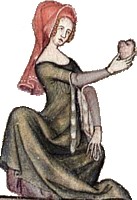
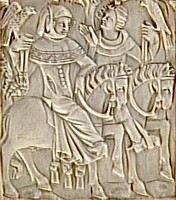
Hoods might be daggued or have a small amount of decorative
needlework as seen on the 14th century French, carved ivory
mirrorcase, shown at right, and the illuminated manuscript at
left.
Written accounts of the uppermost classes tells us that pearls
and gold embroidery were used to decorate hoods and that they
were quite expensive and a far cry from the ulititarian hood
of the working classes.

Copyright
© Rosalie Gilbert
All text & photographs within this site are the property
of Rosalie Gilbert unless stated.
Art & artifact images remain the property of the owner.
Images and text may not be copied and used without permission.
|