|
beauty,
health &
hygiene
general
healthcare
skincare
cosmetics
& perfumes
body
hair
cleanliness
& hygiene tools
bathing
hair
care
hair
styles
oral
care
& dentistry
intimate
feminine
hygiene
|

Medieval
Hair Care
Grooming Tools, Treatments & Colouring
BRUSHES, COMBS & GRAVOURS - HAIR BALMS &
TONICS - HEADLICE & DANDRUFF TREATMENTS - COLOURING THE
HAIR
Brushes
& Combs
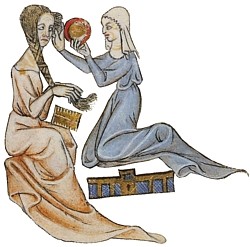
Hairbrushes as we know them today do not appear to be mentioned
during the middle ages. Combs are widely depicted and written
about, not only as a grooming tool, but as a suitable gift from
a lover to his beloved lady.
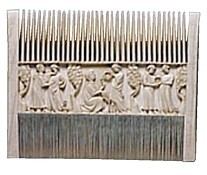 Such
combs were often very elaborately carved or painted with scenes
of courtly love or birds and animals and could be a part of a
toiletries set. Such
combs were often very elaborately carved or painted with scenes
of courtly love or birds and animals and could be a part of a
toiletries set.
Some folded out to form a kind of X whilst others were rigid and
flat like the combs of today. Many show a high degree of fine
workmanship.
Archaeologists have uncovered
some very beautiful examples of boxwood, bone and ivory combs,
like the 1320 ivory comb depicted above at right. It is believed
to be of Parisian workmanship. The design is typical of those
of the period and it is likely to have been owned by a woman in
the upper classes.
 Gravours Gravours
Another hairdressing aide widely used in the middle ages was the
gravour.
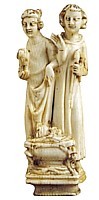
The gravour was a long, slender instrument which looked like an
oversized hairpin. used for parting the hair and probably also
used for partitioning the hair whilst plaiting or styling some
of the more elaborate hairstyles.
Some gravours had beautifully carved handles, as seen here at
the left in this handle dated at 1330 and made in Paris. It shows
a man and a women. The carved tip shown here is 7cm in length.
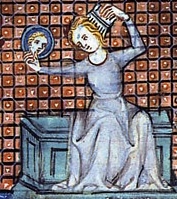
A French Royal account from
1316 describes a set of four grooming instruments: mirror,
comb, gravour and leather case purchased for the sum of 74
shillings, which was an astronomical amount of money in the start
of the 14th century. .
 Hair
balms and tonics Hair
balms and tonics
Medieval women were just as concerned with beauty products for
their skin and hair as women are today.
Many herbal preparations were used to cleanse, protect, lighten
or dye the hair.
Hair loss was also a concern which was attended to with herbal
balms and tinctures. These recipes were found in manuscripts like
the Tacuinum Sanitatus, which were copied and recopied.
Most recipes were herbal, but some had more exotic ingredients.
The Trotula, or the texts attributed to Trotula, include On
Women's Cosmetics, and include recipes for beauty including
a beautiful-smelling hair powder, so that the hair remains sweetly
scented. In the section about On Various Kinds of Adornments,
it reads:
But when she combs her
hair, let her have this powder. Take some dried roses, clove,
nutmeg, watercress and galangal. Let all these, powdered, be
mixed with rose water. With this water let her sprinkle her
hair and comb it with a comb dipped in this same water so that
[her hair] will smell better. And let her make furrows in her
hair and sprinkle on the above-mentioned powder, and it will
smell marvelously.
The entire process of living
history experiment recreating the hair powder according to the
recipe, is here on the TROTULA'S
HAIR POWDER page. It absolutely did smell amazing!
Hair
loss remedies
Hair tonic remedies for hair loss included:
 Aloe
vera, when mixed with wine will assist with hair loss. Aloe
vera, when mixed with wine will assist with hair loss.- Hound's Tongue
leaves bruised or the juice boiled in hog's lard and applied
to the head is good.
- Juice of Onion, Allium
cepa, rubbed on the head then laid in the sun will help.
- Peach tree kernels should
be bruised and boiled in vinegar until they become thick and
then applied to the head is a restorative and causes hair to
grow upon bald places or where it is thinning.
- Quince Tree cotton or
down of quinces boiled and laid as a plaster made up with wax,
brings hair to them that are bald or assists with hair loss.
- Ashes of Southernwood
or Old Man Tree, Artemesia abrotanum, mingled with salad
oil causes hair to grow again whether on head or beard.
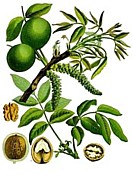
- Walnut, Juglans regia
kernels, shown at right, burnt and taken in red wine stay the
falling of hair on the head and make it fair, being anointed
with oil
- White Maidenhair, the
lee made thereof is singularly good for the skurf, and stays
the falling of the hair, causing it to grow thick, fair and
well-coloured. Boil it in wine, put smallage seed and afterwards,
some oil.
 Headlice
treatments Headlice
treatments
Headlice was as much an issue to the medieval woman as her modern
counterpart and herbal remedies were used to help combat them.
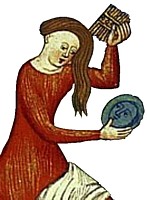
The detail at right is a detail taken from a 15th century French
manuscript by Boccaccio, the de Claris Mulieribus. It shows
a woman using a medieval comb with close set teeth on one side
not unlike our modern headlice combs.
Herbal headlice remedies were the most popular with many suggestions
on offer.
The juice of the young branches of Broom-Rape made into an ointment
with hog's grease and heated as oil was one remedy to kill both
body and head lice. Parsley, Petroselinum crispum, repelled
head lice, as did the oil from the seeds of Spurge or Garden Spurge.
Staves-Acre seeds coarsely powdered and strewed in the hair was
also an option.
Dandruff
treatments
To treat dandruff or a dry, flaky scalp, an infusion of Cleavers,
Galium aparine, not only helped clear the skin but made
a wash for dandruff.
It was also believed that the leaves or bark of the Willow tree
in wine would take away dandruff by washing with it and a wash
of the juice of beets with water and vinegar cleansed the head
of dandruff and was warded off the shedding of hair. As would
the head washed with Lesser Field Scabious.
Colouring
the hair
According to treatises which contain herbal remedies, medieval
women did indeed dye their hair. Although blonde was the often
preferred and most fashionable colour, recipes for darker hair
were known, perhaps to disguise grey hairs as they are today.
One assumes that these recipes were intended only for townswomen
who had access to such ingredients or the funds to purchase them.
The advice from the Old Women in the popular medieval manuscript
the Roman de la Rose offers this advice for colouring the
hair:
..and if they need colour,
she should dye them with many different plant-extracts, for
fruit, wood, leaves, bark and roots have powerful medicinal
properties.
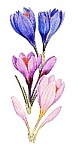 Saffron
or Saffon or Saf-Flower crocus sativus, shown at right,
was a popularly used hair dye, although to produce which colour
is uncertain. Possibly blonde. Saffron
or Saffon or Saf-Flower crocus sativus, shown at right,
was a popularly used hair dye, although to produce which colour
is uncertain. Possibly blonde.
Recipes to turn the hair
yellow include-
- The hair when washed with
the lie made of ashes of the Barberry tree and water, will make
it turn yellow.
- To dye the hair yellow,
honey and white wine left overnight on the hair then a mixture
of calendine roots, olive-madder, oil of cumin seed, box shavings
and saffron was recommended. Wash off after 24 hours.
Recipes to turn the hair
black include-
- Gall Oak omphacitis coals
of burned galls being quenched in wine or vinegar;
- the leaves of bramble
boiled in rye, a recipe which was perhaps available to poorer
women who lived in the countryside and did not have the stuffs
of the towns freely available to them.
- a mixture of iron, gall
nuts and alum boiled in vinegar and left on the head for two
days was recommended.
- Both Hortus Sanitatis
and Dioscorides claimed that sage tea, Salvia officinalis
dyes the hair black, although the Tacuinum Sanitatis
indicated that Sage removes dark colour from the hair..
- Schroeder says
women in Germany use the
buds of Black Poplar to make their hair grow thick and ornamental,
although he does not state how.
According to Trotula, opal
necklaces were a favourite with blonde ladies as it was considered
that opals protected fair hair from fading or darkening. Where
they got opals from, is not mentioned.

Copyright
© Rosalie Gilbert
All text & photographs within this site are the property
of Rosalie Gilbert unless stated.
Art & artifact images remain the property of the owner.
Images and text may not be copied and used without permission.
|
