HOME CLOTHES & ACCESSORIESFABRICS & SEWINGGLOSSARY of CLOTHING TERMSBEAUTY & HYGIENEMANNERS
SAINTSA WOMAN'S LIFE
HISTORICAL RE-ENACTMENTMY RE-ENACTMENT LIFEMY NOTICEBOARDBIBLIOGRAPHYLINKSMY SUPPLIERSSITE MAPEMAIL ME

BIRTHS

WEDDINGS

DIVORCES

DEATHS

EDUCATION

EMPLOYMENT

RECREATION

FEAST DAYS & RELIGIOUS CELEBRATIONS

Recreation
Passtimes and hobbies
BOARD GAMES - MUSIC - EMBROIDERY - HAWKING - HORSE RIDING - HUNTING

Medieval women did find time for recreational activities. There were many religious holidays during the year which provided a break from regular work.

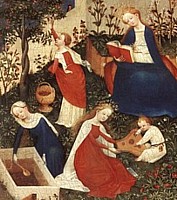
The detail at right is from a painting from 1410, The Garden of Eden. It shows women relaxing in a beautiful garden setting with a variety of flowers. They are engaged in music, berry-picking and reading- all genteel pursuits suitable for a woman of good breeding.

Simple pleasures like flower-picking were available to both peasant women and nobles alike. Pursuits such as board games were available to most women, although elaborate boards and playing pieces were the domain of the wealthy alone. Hawking was a sport which was available to noble women only.

Board games
Two of the most popular board games during the Middle Ages were chess and tric-trac, which we now call backgammon.

Playing boards could be simple but most of those which have survived today show elaborate inlaid panels or painted boards and pieces which were skilfully carved. Merrils or Nine Man's Morris was also played but these do not seem to have been afforded the same level of workmanship with either boards or playing pieces.

Shown at left is a painted and inlaid tric-trac board with gold gilding and rose-and-lily central design. The board itself is hinged but does not have a designated area for bearing off at the end of the game. Shown at right is a scence from the 1345 manuscript, The Luttrel Psalter. It shows a man and a woman engaged in a game of tric-trac. Unlike cards, this was a game which could be played by ladies.

Chess was a game which was also popular with female nobility and women in the upper classes, and pieces were carved out of materials which ranged from simple wood to bone and ivory. Naturally, ivory chess sets were exclusively the domain of the wealthy. Shown at right is a common bone chess set from the 14th century from Scandinavia. It is housed in the Musée National du Moyen-Âge, in Cluny, France.

The detail at left is taken from the Manesse Codex, a German manuscript from 1300-1320.


The rules for medieval chess were mostly similar to those which we have today, with only a few variations. The pieces moved as follows:

- The king moved as normal.
- The rook moved as normal.
- The knight moved as normal.
- The pawns only travelled one square, even on the first move.
- The bishops moved diagonally only two squares but could jump other pieces.
- The queen moved diagonally only, and one square at a time.
- Stalemate and Checkmate were the same as today.
- Baremate also existed if a king was left with no pieces.


Music
Most accomplished noble women were expected to be proficient on at least one musical instruments. Many manuscripts show women playing music or surrounded by female angels who play musical instruments.

Women performed as singers and musicians, either in the home or in more formal court settings.
Many of the courtly romances of the twelfth, thirteenth and fourteenth centuries write of women singing and playing musical instruments. In the Cleriadus et Meliadice, girls as well as boys perform singing and on the harp. Ibed writes that, "There might you have heard men and women singing well!" Boccaccio's Decameron identifies women singing and dancing along with their male companions. The image shown above comes from an unknown source.

Embroidery
Fine silk and gold embroidery was another socially acceptible passtime for women of all classes. Although this could also be a more practical employment for wages, most women were able to demonstrate their fine needlework on veils, bags, belts, garters and girdles. Much of this kind of embroidery was done for enjoyment.

Hawking
Hawking was an extremely popular pursuit amongst noble women who could afford the cost and upkeep of birds and the staff to care for them. Falconry was not a sport for the income-challanged.

The image detail at right shows a woman with her bird of prey and hawking glove. It comes from the Holkham Bible of 1325-1335.

Horse riding
Women first rode astride as men did, sitting on saddles the same way most women ride today. Art from the fifth century in the orient and in European, shows women in long skirts riding astride. Some hawking illustrations, like the German1300-1320 manuscript (shown at left, the Manesse Codex , also show women on horseback riding astride.

There are only a few referances to women's riding abilities, but these include Anne of Bohemia (1366-1394) , Queen Isabella of Spain (1451-1504) and Catherine de Medici (1519-1589). Certainly if these women rode, it is likely they would have been accompanied by female staff who rode with them. As illustrations from the Manesse Codex show, riding was not limited the nobles and queens, but was the passtime of noble ladies as well.

Anne of Bohemia is believed to have introduced the earliest version of a sidesaddle. Although not entirely not like today's saddle, the medieval side-saddle was a basic chair-like saddle with a small foot rest known as a planchette. From 1300 up until 1900, side-saddles evolved into the one we know today.

Catherine de Medici also made a significant contribution to the development of the side saddle for women riders. She had several bad falls whilst hunting, and as a result, she started to adopt a more forward-leaning seat. She hooked her right leg around the pommel of the saddle. Eventually, she adding an extra horn on the near side of her saddle to support her right knee and maintain her balance.

A cross-country ride by Queen Isabella of Spain shows the skill of a long-distance endurance ride by a determined women. It is recorded that Isabella rode side saddle over the Spanish countryside when she wished to to discover for herself the true state of her nation's political problems. This was by no means a short or easy journey.

Hunting
It seems that sometimes noble women did hunt for sport, although illustrations showing women doing so are very limited.

One image, source unknown at right, shows four medieval women in a hunting scene. One uses a bow and arrow, one tends the hunting dogs, one chases a deer out of a forest and one blows the hunting horn.


Copyright © Rosalie Gilbert
All text & photographs within this site are the property of Rosalie Gilbert unless stated.
Artifact images remain the property of the owner.
Images and text may not be copied and used without permission.